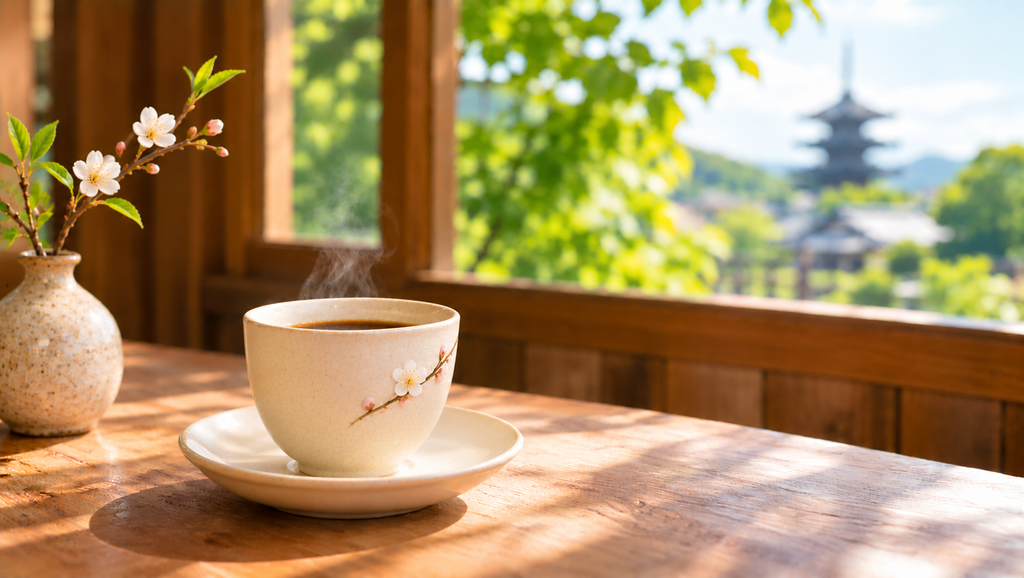
The Art of Enjoying Life
WISH JAPON — Building a Small Future in Kyoto | Part 1
In Japanese, there are so many words for rain.
Kosame (light rain), kirisame (misty drizzle), samidare (early summer rain), shigure (passing showers in late autumn or early winter), akisame (autumn rain)…
Each has its own name, depending on the season, the way the rain falls, or the scenery it evokes.
These expressions remind us how deeply rain is woven into Japan's landscape and everyday life.
But what about the word enjoy?
Japanese, of course, also has a rich variety of expressions: mankitsu suru (to enjoy something to the fullest), tannō suru (to savor something deeply), ōka suru (to revel in a period of life), kyōjiru (to take pleasure in an activity), tashinamu (to cultivate and enjoy a pastime), and mederu (to admire and delight in something beautiful).
Yet each seems to carry its own distinct meaning and character, somewhat removed from the simple word tanoshimu — to enjoy.
In English, on the other hand, how many words there are that directly express different aspects of enjoyment!
Enjoy, Relish, Savor, Appreciate, Delight, Pleasure, Joy, Gratifying, Pleasant…
Each word seems to capture a slightly different way of experiencing enjoyment, at least as we understand it.
Fun is about amusement and having a good time.
Pleasant suggests comfort and a sense of ease.
Relish is about savoring an experience and taking genuine pleasure in it.
Gratifying describes the satisfaction we feel when our efforts bear fruit or when we know we have made a difference to someone.
And Joy suggests a deeper happiness, something that wells up from within.
Most of us would agree that life is meant to be enjoyed.
Yet in Japan, there is sometimes a tendency to associate “enjoying life” simply with having fun, seeking entertainment, or indulging in pleasure.
But surely that captures only a small part of what enjoyment can mean.
There must be forms of enjoyment that are more profound, perhaps even noble.
Encountering something beautiful and appreciating its extraordinary qualities.
Spending a peaceful moment in a comfortable, welcoming space.
Becoming absorbed in something and discovering a joy that is uniquely our own.
Knowing that our work has helped someone and being thanked for it.
Being able to do something today that we could not do yesterday.
These individual experiences can bring a quiet yet profound sense of joy.
Enjoying life is not simply about doing enjoyable things, but about savoring the richness of life itself.
We find ourselves wondering what Japanese expression might capture the nuances of Joy, Relish, Gratifying, and Pleasant, rather than simply Fun.
The World Is So Much Bigger Than We Imagine
Having a disability should never mean having to experience a smaller world.
The world is full of beautiful things, extraordinary achievements, and experiences that can move us deeply.
Everyone should have opportunities to encounter art of the highest caliber.
Everyone should have the chance to connect with a favorite athlete or sports team across national borders.
Enjoying delicious food, admiring beautiful landscapes, discovering unfamiliar cultures and different ways of thinking.
We want people to have more and more opportunities to enjoy these wonderful experiences.
In fact, we have long been thinking about ways to help young people with disabilities — and, of course, people of other generations as well — connect with the wider world through art and sport.
Some of our ideas may sound a little unconventional!
For example, we have arranged opportunities to experience the artistry of London's Royal Ballet, considered one of the world's leading ballet companies.
And for young baseball fans, we reached out to the Los Angeles Dodgers and received a special certificate recognizing them as valued fans.
Why shouldn't everyone have experiences like these?
“The world you live in is so much bigger than you might imagine.”
“Having a disability doesn't mean you are disconnected from the wider world.”
These are things we hope to communicate not simply through words, but through experiences that people can genuinely feel and remember.
Because a Secure Everyday Life Matters
Of course, having extraordinary experiences does not, by itself, guarantee happiness.
Having a secure and comfortable everyday life is just as important, if not even more so.
Having a place we can always return to.
Being able to find one's own role.
Feeling that we are needed by others.
And knowing that we can continue working in the same place tomorrow, next year, and for years to come.
Having these things in everyday life may allow people to feel secure enough to look towards a wider world.
When thinking about employment for people with disabilities, continuity is especially important.
Rather than creating temporary opportunities to work through occasional events, we want to create a place where people can continue working with confidence and peace of mind over the long term.
And where the work itself brings them a sense of joy and fulfillment.
A secure, stable everyday life, alongside opportunities to discover a much wider world.
We want to create a place where these two things can coexist.
With this in mind, we have begun a small project in Kyoto.
WISH JAPON
We are developing a place that combines a café where people with disabilities can work with a small guest accommodation facility, and preparations are underway.
If We're Going to Open a Café, Why Not Make It Exceptional?
When you hear about a café employing people with disabilities, what sort of place do you imagine?
Our goal is not to create a café that people visit simply because they want to support people with disabilities.
We want people to come because the coffee is delicious.
Because the atmosphere is welcoming.
Because they genuinely want to return.
A café that naturally attracts customers for these reasons.
And among the people working there, some happen to have disabilities.
It is simply part of the everyday scene.
That is the kind of place we hope to create.
Which is why we do not want to compromise on the quality of what we serve or the atmosphere we create.
Perhaps we're being a little picky!
Take the tableware, for example.
Near the top of Chawanzaka, a historic street in Kyoto known for its pottery, there is a wonderful shop specializing in Kiyomizu ware called Tosai (東哉).
Their tea cups are truly exceptional.
The angle at which the rim meets the corners of your mouth, and the delicacy of that sensation, are extraordinarily pleasant.
It is surprising how much the experience of drinking the very same tea can change depending on the cup.
Tosai's official website: https://www.to-sai.net/
But comfort is by no means limited to special things.
If we are going to pay attention to the smallest details of everyday life, then even the quality of the toilet paper we provide in the café matters to us!
Some might wonder whether that is taking things a little too far.
But as the saying goes, “God is in the details.”
It's not about making everything expensive, but about choosing things that are good for us, both physically and emotionally, and creating a space where everyone feels comfortable.
And this is not just for our guests.
We want everyone working there, including those with disabilities and the colleagues working alongside them, to feel at ease in their surroundings and proud of what they do.
If a cup of coffee served in such a space can bring a small moment of pleasure or happiness to both the customer and the person serving it, that would be wonderful.
Perhaps this, too, is a combination of Pleasant, Gratifying, and Joy.
Good Intentions Alone Are Not Enough
Even the best intentions mean little if the business cannot sustain itself.
Opening a café is not the ultimate goal.
What matters most is creating a place where people can continue working for many years.
To achieve this, we need to offer services that customers genuinely choose and build a business model that can remain sustainable.
We are also exploring ways to create a wider variety of jobs, including serving customers in the café, assisting with food preparation, cleaning the guest accommodation, and finding opportunities to use social media and AI.
Everyone has different strengths and challenges.
Some people enjoy interacting with customers.
Others may prefer concentrating carefully on a particular task.
What if each person could find a role that suits them?
What if their work could bring joy to others?
And what if the entire arrangement could continue sustainably, year after year?
That is the kind of place we hope to build.
So Why Not Go and See the World?
Naomi, who will take responsibility for the café, has many years of experience supporting employment for people with disabilities.
The rest of us, however, are not specialists in this field.
There is still so much we do not know.
So we thought: why not go and see how others are doing it, both in Japan and around the world?
There are cafés and hotels across the world where people with disabilities work and participate naturally in their local communities.
We do not want simply to visit successful projects and admire them.
We want to understand how they actually work.
How are jobs created?
How is the quality of service maintained?
Do the people working there genuinely enjoy what they do?
Do they feel pride and satisfaction in their work?
And, perhaps most importantly, what makes it possible for them to continue working over the long term?
We want to see these places for ourselves, talk with the people involved, and reflect on what we discover.
We also want to learn sincerely from the wisdom and experience of those who have paved the way.
Through this series, we hope to share what we discover during our visits in Japan and overseas, along with the progress of WISH JAPON in Kyoto.
From a Small Place in Kyoto to the Wider World
WISH JAPON is still in its early stages.
The renovations and the practical arrangements for running the café and guest accommodation are only just beginning in earnest.
Things may not turn out exactly as we imagine.
There will almost certainly be challenges and moments when we have to reconsider our plans.
Even so, we hope to shape this project little by little, together with the people we meet in Japan and around the world and those who will work alongside us in Kyoto.
We have also decided to keep a record of the journey.
Not just to introduce the finished café, but to share the process of creating it.
The wonderful initiatives we encounter in Japan and overseas.
The things that surprise us, inspire us, or leave us with questions.
And the trial and error involved in building something new in Kyoto.
We hope to write about all of this as openly as we can.
Someone, somewhere, may be thinking about doing something similar.
Or someone working in a completely different field might find an idea here that interests them.
If this series creates such connections, we would be delighted.
The art of enjoying life.
Enjoying life is not just about having extraordinary experiences. It is also about finding small moments of joy in everyday life and work, and building on them day by day.
With or without disabilities.
We hope everyone can discover their own sources of happiness, feel the vastness of the world and their connection to it, and live with a sense of security.
From a small café in Kyoto, we may begin to create a place where all of these things come together.
Japan offers so much to savor deeply. And the world is vast.
There is still so much in life to enjoy.
We look forward to sharing more details about WISH JAPON, including its location and facilities, once the renovations are complete.
Coming Next: Two Approaches to Inclusive Employment in Bangkok, Thailand
60 Plus Bakery & Café and STEPS.
In the same city, we visited two organizations taking different approaches to creating employment opportunities for people with disabilities.
We will share what we saw, what we felt, and how these experiences might help shape our own project in Kyoto.
WISH JAPON